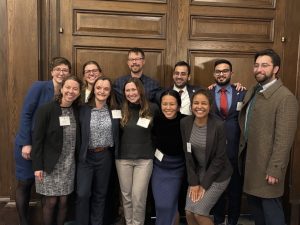
Research is one of the foundational pillars in the UW–Madison Department of Surgery. That is reflected throughout the department, including the trainee programs. All three of our residency programs provide trainees opportunities for dedicated research time.
“I am very interested in pursuing research, so the opportunity to combine research with a fantastic surgical training program was something that really drew me in initially to Wisconsin,” Dr. Jack Bontekoe, vascular surgery resident, said.
During this protected research time, residents learn essential skills that set them up to have a successful career after graduation. They are given opportunities to publish papers, present at local and national conferences and build relationships with researchers on campus and across the country, all while getting support from the department.
“In my role, I want to make sure that our resident trainees and our post docs have excellent research experiences,” said Dr. Luke Funk, Co-Vice Chair of Research in the Department of Surgery. “We also want to ensure that they have great mentorship and are able to go on and have successful careers.”.
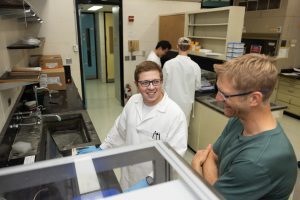
Over the course of their research time, residents publish in peer-reviewed journals and have opportunities to be first author on these publications.
“I’ve had the opportunity to publish a couple of papers, hopefully I’ll have three by the end [of my research time],” Dr. Patrick Carney, general surgery resident, said.
The Department of Surgery also encourages residents to submit their research to conferences. Seven residents presented at the 2025 ACS Clinical Congress, and more have presented at conferences such as the Academic Surgical Congress, American Society for Reconstructive Microsurgeons, Society of Surgical Oncology and many others.
“Just having the support of the department to go out and disseminate our work both at local and national conferences has been one of the biggest opportunities to really network and truly appreciate what it’s like to be an academic surgeon-scientist,” said Dr. Kate Lauer, general surgery resident.
At these conferences, residents are also given opportunities to compete and share innovations at a national level. In 2025, Dr. Jasmine Craig, plastic surgery resident, won the American Society of Plastic Surgeons Inventors Challenge.
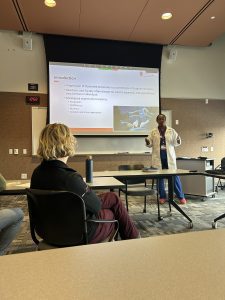
“That was an opportunity that I thought was amazing both to develop the skills required to do that and also to have a national platform to share the innovation we are working on,” Dr. Craig said.
At the center of all of these research opportunities is collaboration. In the Department of Surgery, we recognize the strength of our diverse experiences and believe our greatest path to success is through working together.
“It’s been great to have the chance to work with so many of the research staff in the department that I haven’t had the chance to work with clinically and realize that there is a huge team of people doing amazing work that I just didn’t know before,” Dr. Ben Cher, general surgery resident, said.
Research residents have many opportunities for collaboration between labs in the department, but also with other groups on campus. Current research residents have worked with the Department of Biomedical Engineering, Department of Pediatrics, Department of Internal Medicine, Department of Economics, Department of Population Health and Epidemiology, the School of Veterinary Medicine, the UW–Madison Biotechnology Center among others.
“Without those cross-departmental collaborations, our projects wouldn’t be possible,” said Dr. Lauer.
In addition to publishing, presenting and collaborating, residents have had access to additional opportunities with the help of their mentors.
“My main passion is LGBTQ health for surgeons, which isn’t something that anyone in the department studies dedicatedly, so I’ve had a lot of help from my mentors in regards to developing my own projects, which has been great,” said Dr. Amber Sheth, general surgery resident.
Overall, residents are grateful for their dedicated research time.
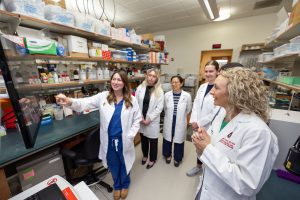
“I think it’s really important to take a step back from the busy clinical environment and develop these other areas,” said Dr. Lauer. “And the only way to do that effectively is to truly remove yourself from that setting and be able to devote yourself entirely to this type of work.”
For some residents who previous had limited exposure to research, this time has taught them about the different aspects of research.
“I did not have a lot of research experience before this at all,” said Dr. Faith Dickerson, general surgery resident. “In general, getting exposed to research and how that works – publishing, submitting things, conferences – all of these things were pretty new to me so that’s all been very helpful.”
This protected research time also sets residents up for success after graduation.
“It helps to get the experience, like presenting at these conferences, to set up a career in academic surgery,” said Dr. Carney. “Wanting to do academic surgery and have a basic science lab, it’s important to have time during training to do research, to keep a good publication record, to present at conferences, and to learn how to balance that lifestyle with surgery.”
Even residents who are not pursuing research after their residency have found this dedicated time helpful.
“I think it’s also important as somebody who isn’t necessary interested in having my own lab to understand and become more familiar with the spectrum that exists and how you can still contribute to the field and advance our understanding on how we manage patients without that having to feel like a full-time job,” said Dr. Lauer.
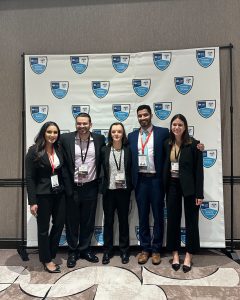
Wisconsin Surgery is proud to offer many different opportunities to residents during their dedicated research time. Research is at the core of the department, and it is something that we are committed to fostering within each new generation of surgeons.
“I honestly believe that recruiting top talent from medical school who will go on to become future surgeons is probably the most important thing we do,” said Dr. Rebecca Minter, A.R. Curreri Professor and Chair of the Department of Surgery. “That’s the next generation who will take care of all of us and who will generate the next wave of discovery.”