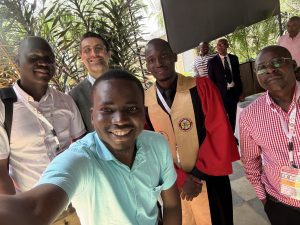
In late November and early December of 2025, I traveled to Burundi and Uganda for two interconnected global surgery activities: the annual College of Surgeons of East, Central and Southern Africa (COSECSA) scientific conference and examinations in Bujumbura, and an on-site mentorship and program development visit to Mbale Regional Referral Hospital in Uganda. This trip marked my first global surgery visit as a part of the UW–Madison Department of Surgery faculty.
The first leg of the trip brought me to Bujumbura for the COSECSA annual meeting. This conference serves as the premier regional gathering for surgeons across East, Central, and Southern Africa, and it was a meaningful opportunity to engage with surgical leaders from across the region. Most importantly, I was there to support residents from the Mbale surgical training program who had come to present their research, sit for their COSECSA examinations and, in one deeply memorable case, graduate.
Witnessing a resident complete his training and receive his certificate as an orthopedic surgeon was a powerful moment — a tangible milestone that underscored the impact of sustained, long-term capacity-building efforts. Seeing these trainees stand on an international stage and present their work with confidence reinforced the value of locally driven research and the importance of creating pathways for trainees in low-resource settings to participate in regional academic discourse.
The conference also provided a valuable opportunity to connect with surgical educators from across the region, share outcomes from the Mbale program, and identify areas of overlapping interest — including rural surgical skills training initiatives being developed in the DRC that offer exciting potential for future collaboration.
The second component of the trip was a site visit to Mbale Regional Referral Hospital, where I spent time with the surgical residency program that I have been involved in supporting since its inception in 2021. What began with a single trainee has grown into a thriving cohort of 20 Ugandan surgical residents.
During this visit, I held mentorship sessions with the residents, focusing on their individual research projects, clinical development and career trajectories. I also facilitated group workshops aimed at expanding ongoing research efforts, generating new project ideas and advancing curriculum development for the upcoming academic year. Strategic discussions with local faculty and hospital leadership centered on strengthening research infrastructure, introducing improvements to the medical records system to better support both clinical care and research and reinforcing the support structures that help residents succeed. Reflecting on the program’s growth — from a single trainee to a structured, expanding residency — I was struck by how much had changed in just a few years, and how much the investment in this partnership has meant not only for the trainees themselves, but for the patients they serve.
This trip also offered valuable comparative insight into the healthcare system in Burundi, providing a broader regional perspective on the shared challenges and innovations across East Africa. This work represents a long-term, longitudinal commitment to global surgery partnership. I am proud of the progress we have made together and am committed to continuing to advance surgical education, research capacity and program development at Mbale as I begin my faculty role at UW-Madison.
Dr. Saad Sahi is an assistant professor in the Division of Acute Care and Regional General Surgery.