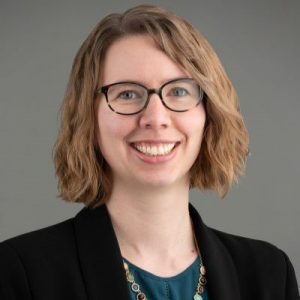
Division of Colorectal Surgery Assistant Professor Ana De Roo, MD, MSc hopes to spend her career improving clinical processes and decision-making so patients with cancer are supported, informed, and receive care that is aligned with their personal goals and preferences. With a new 5-year, $715,000 grant from the American Cancer Society’s Clinician Scientist Development program, she will be taking the first steps to achieve her long-term goals.
De Roo specializes in the surgical treatment of colon and rectal cancer as well as other diseases that affect the colon, rectum, and anus. Every year, over 45,000 people are diagnosed with rectal cancer, and many of these patients face a combination of treatment that includes radiation, surgery, and chemotherapy, which can have significant side effects that impact the patient’s quality of life. But for patients with locally advanced rectal cancer (LARC), which refers to Stage II and III rectal cancer that has not spread to distant organs, there’s some evidence that radiation or surgery can be selectively omitted while maintaining cancer outcomes.
“De-escalating treatment can spare patients with LARC from some of the negative effects of these treatments, which can include bowel, bladder, and/or sexual dysfunction or a permanent colostomy,” explained De Roo. “The problem is that clinicians currently have limited guidance on how to support patients in making a decision to de-escalate treatment when the decision is complicated by how the patient is responding to early treatment efforts, requires buy-in from and coordination across the multidisciplinary treatment team, and it needs to be balanced against the long-term impact of the cancer and its treatment on the patient’s daily life.”
Working with research teams at the UW and the University of North Carolina-Chapel Hill, De Roo aims to develop a patient-focused communication tool that will help clinicians better handle this decision-making process. Guided by a model that has been used to study and improve patient safety and healthcare quality, she plans to interview both clinicians and patients to determine how these decisions are currently approached so she can identify content, timing, and delivery format issues that could be improved. She then plans to build on an existing communication framework developed by UW’s Morgridge Professor in Vascular Surgery Dr. Gretchen Schwarze, called Better Conversations, which is intended to help surgeons have more effective and transparent discussions with patients and their families when making high-stakes surgical decisions. De Roo’s intent is to develop a LARC-focused Better Conversations intervention that she can pilot test.
“Patients and clinicians need help navigating a complex, uncertain treatment pathway that can have long-term consequences for the patient’s quality of life,” said De Roo. “By adapting the Better Conversations framework to LARC, I hope to create a tool that will make these conversations and decisions more manageable. This research could also become a template that can be applied in other types of cancer where de-escalation of treatment is an option. I’m incredibly thankful to the American Cancer Society for their support as I launch my career as an independently-funded clinician-scientist.”