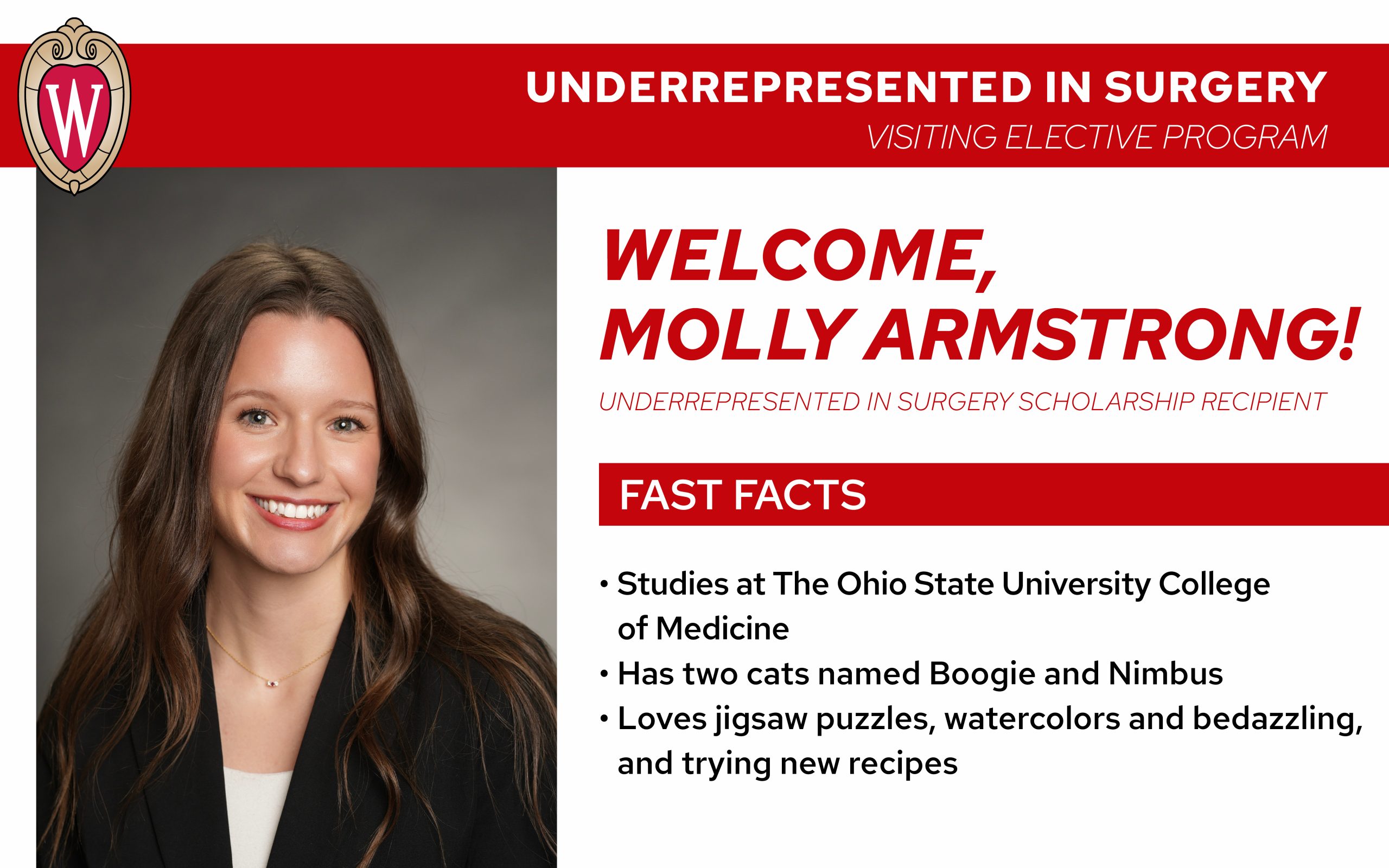
The Underrepresented in Medicine (URiM) Visiting Student Scholarship Program, sponsored by the Department of Surgery, supports qualified 4th year medical students from underrepresented backgrounds in medicine in developing their clinical skills, abilities, and potential through a visiting rotation, mentorship, and networking opportunities.
Molly Armstrong, a medical student at The Ohio State University College of Medicine, was originally interested in psychiatry because of the trust required for a patient to let a physician into the deepest parts of their life. At the same time, she was also drawn to fields that demanded technical precision and offered an immediate, tangible impact. Surgery brought these two interests together.
“Vascular surgery solidified itself as my path early in clinic, when a patient shared that of all his loved ones, he was most excited to tell his vascular surgeon that he had quit smoking,” Armstrong said. “That interaction showed me that success in the field is measured not only by technical outcomes, but by the strength of relationships sustained over years of surveillance and care.”
During her first year as a medical student, Armstrong had a shift at Clínica Latina, a free clinic, where she learned the importance of trust and advocacy in patient care. She met a patient with uncontrolled hypertension and diabetes whose medication use appeared inconsistent.
“After reviewing his prescriptions together, I realized the issue wasn’t unwillingness, it was that his instructions were only printed in English,” Armstrong said. “That taught me advocacy could start with something as simple as translating a medication sheet, and that trust develops through consistency and small acts of connection.”
Armstrong is especially interested in vascular surgery because of the breadth of the field. With a working knowledge of medical management paired with surgical skill, vascular surgeons meet patients wherever their disease presents and respond effectively to the full spectrum of a patient’s needs.
One of the reasons Armstrong was drawn to the UW–Madison Department of Surgery is its camaraderie.
“Conversations with my mentors and a current resident painted a picture of a genuinely collegial culture, with strong faculty investment in trainee growth and an emphasis on graduated responsibility,” Armstrong said.
In addition to the culture, Armstrong was interested in the program’s clinical depth, particularly the exposure to diverse vascular pathology across multiple hospital settings.
“As one of the first integrated vascular surgery programs, UW represents a kind of blueprint for contemporary vascular training, and I am grateful for the opportunity to join the team for a month,” Armstrong said.
During her rotation, Armstrong is eager to train at a variety of locations, including the VA where she is excited to contribute to the care of veterans.
“I’m also looking forward to dedicated mentorship from faculty and residents that I’ve already heard excellent things about,” Armstrong said.
In the future, Armstrong’s goal is to become a well-rounded, technically competent academic vascular surgeon.
“I’m especially interested in the patient experience surrounding AAA repair and surveillance, an interest reflected in my current research, a systematic review examining psychological distress in patients undergoing AAA surveillance,” Armstrong said. “Long-term, I want a career that combines operative practice with research and academic work focused on improving that experience, helping patients navigate the uncertainty of long-term monitoring.”