Anal cancer is a rare cancer in humans, but its incidence and mortality has steadily increased over the last decade in the U.S. Despite that growth, stigma surrounding anal cancer increasingly stifles the conversation around the disease, which subsequently hinders the research. Evie Carchman, MD, an associate professor in the Division of Colorectal Surgery, is working to bring that conversation out of the shadows and advance the study of the disease.
The incidence of anal cancer is approximately two in 100,000 people, defining it as a rare cancer, but these rates have been steadily increasing by 2% per year. In 2025, there were an estimated 11,000 new cases in the United States. The good news is the disease is curable, as the five-year survival rate hovers around 70 percent. However, that rate drops dramatically if the disease is diagnosed in the later stages.
“My interest came down to the fact that there wasn’t a lot of research being done on anal cancer,” Dr. Carchman said. “We see a fair number of patients in clinical practice that have been treated for anal cancer, and even though they’re cured most of the time, they live with long-term effects.”
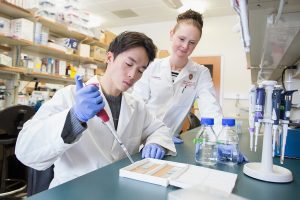
Dr. Carchman’s lab focuses on anal cancer prevention and treatment. Through the use of genetically engineered mice, Dr. Carchman’s lab examines the pathways important in the development of anal cancer and tests the ways in which key intracellular pathways can be altered to prevent the development and improve the treatment of anal cancer.
“It’s critical that we identify markers of risk, disease behavior, and response to treatment for patients with precancerous anal lesions so we can better tailor our surveillance and treatment plans.”
— Dr. Evie Carchman, associate professor, Division of Colorectal Surgery
Additionally, Dr. Carchman is currently analyzing how precancerous lesions called anal dysplasia develop into anal cancer. While evidence suggests that treating these lesions can prevent the development of anal cancer, researchers still don’t understand exactly how and why a lesion changes to ultimately cause cancer to develop.
“Recent changes to screening and treatment guidelines are going to significantly increase the number of patients with anal dysplasia that will be identified, which is great from a cancer prevention standpoint. But there are three big unknowns that we still need to tackle to ensure we can provide the best care possible for these patients,” Dr. Carchman explained.
Researchers have yet to identify patient-specific predictors of who is likely to progress to cancer and will thus require more aggressive treatment or surveillance. Additionally, the factors that determine which patients are likely to respond to current or new therapies have not been identified. And lastly, new treatment options are needed; currently available therapies are limited and are associated with harmful side effects and high rates of the lesions coming back.
“It’s critical that we identify markers of risk, disease behavior, and response to treatment for patients with precancerous anal lesions so we can better tailor our surveillance and treatment plans,” Dr. Carchman said. “Not every patient that has anal dysplasia is going to go on to get cancer, but there’s not enough research in anal dysplasia for us to be able to tailor our screening practices.”
While funding for research into rare cancers, such as anal cancer, is hard to come by, Dr. Carchman recently received a one-year, $50,000 research grant from The Research Foundation of the American Society of Colon and Rectal Surgeons to support her work.
“We have a lot of expertise on campus and this university is very collaborative … I feel like everybody is willing to take the time to invest in someone else’s success.”
— Dr. Evie Carchman, associate professor, Division of Colorectal Surgery
Being infected with human papillomavirus (HPV) is the main risk factor for anal cancer. While people with healthy immune systems are usually able to fight HPV infections, those who have weakened immune systems and are infected with HPV have a higher risk of anal cancer. For example, HPV infection is common among people who are living with HIV, a disease that weakens the body’s immune system and its ability to fight infection. Additionally, people with HPV who have received an organ transplant and are taking immunosuppressive medicine to prevent organ rejection have an increased risk of anal cancer.
“A lot of patients don’t want to identify themselves as anal cancer survivors because there’s sort of a sexual stigma associated with it,” Dr. Carchman said. “We can’t change anatomy. It is what it is. No one’s offended by breast cancer or cervical cancer. I think that’s been one of the barriers in trying to get buy-in in terms of informing the community of the results we’re having or helping in terms of dissemination.”
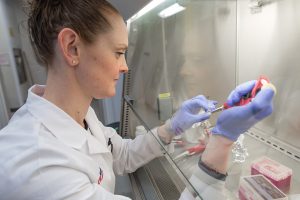
Despite those challenges, Dr. Carchman and her lab have seen progress. Collaborations across campus and the School of Medicine and Public Health have been enormously helpful in that progress, including research partners in radiology, gynecology, oncology, radiation oncology, the Center for Precision Medicine and the McCardle Laboratory for Cancer Research, among others.
“We have a lot of expertise on campus and this university is very collaborative,” Carchman said. “We have so many resources and everybody’s willing to help you tap into those resources. And if they don’t have direct connections to it, they find someone who does. I feel like everybody is willing to take the time to invest in someone else’s success.”
Another benefit of working at UW-Madison is the access to top-level surgery residents. Dr. Carchman has held numerous training roles during her 12 years at UW and currently serves as the co-director of Postdoctoral Research Training. Helping the next generation of surgeon scientists is a passion of hers and was recently reflected in Dr. Carchman receiving a Distinguished Faculty & Staff Postdoctoral Mentoring Award from the School of Medicine and Public Health.
“[Dr. Carchman] is invested in and cares deeply about student and trainee professional development, and she goes above and beyond to support and advocate for mentees, both professionally and personally.”
–Dr. Corinne Praska, resident, General Surgery Residency Program
“Working in Dr. Carchman’s lab has been an incredibly valuable experience,” said Corinne Praska, MD, a general surgery resident in her second year working with Dr. Carchman. “She is invested in and cares deeply about student and trainee professional development, and she goes above and beyond to support and advocate for mentees, both professionally and personally. It’s clear that her patients serve as the primary motivation behind the research she does, and this passion permeates all aspects of her work. I feel fortunate to get to work with and learn from her.”
For more than 12 years, Dr. Carchman has dedicated her career to the study of anal cancer. That has included numerous clinical trials, establishment of a biorepository and database for anal dysplasia and anal cancer to help with future research, launching a program to educate UW Health personnel about the patient populations at risk for anal cancer and dysplasia and serving on a patient advisory board to involve patients in research and community efforts for anal dysplasia and cancer awareness, prevention and treatment. So what does she see in the future for this disease?
“The short-term goal is that one of the drugs we have in clinical trial now is a better treatment for anal dysplasia in terms of cancer prevention,” Carchman said. “We’re also trying to look for molecular markers to help in terms of precision medicine. I’m hoping that the drug that we have in a phase one clinical trial now might be something that we can offer to patients to help with anal dysplasia treatment and thus cancer prevention.”
If you would like to support the ground-breaking research happening in the Carchman lab or throughout the Department of Surgery, please visit our “Give” page or contact Lindsay Kindschy, Director of Development.
By Brian Lucas, Director of Marketing and Communications