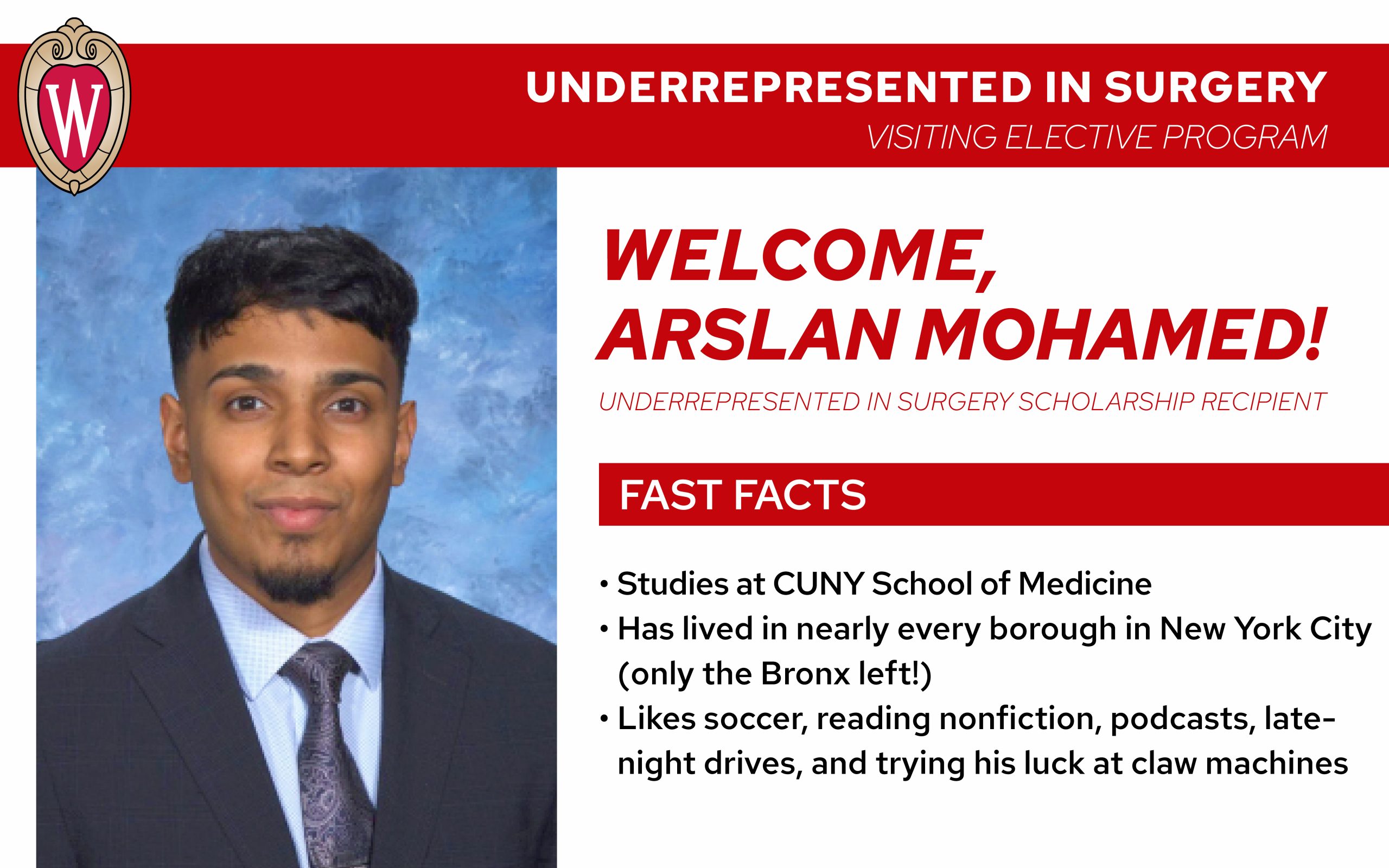
The Underrepresented in Medicine (URiM) Visiting Student Scholarship Program, sponsored by the Department of Surgery, supports qualified 4th year medical students from underrepresented backgrounds in medicine in developing their clinical skills, abilities, and potential through a visiting rotation, mentorship, and networking opportunities.
Arslan Mohamed’s interest in surgery began in childhood, after witnessing his uncle’s experience as an amputee. Following a road accident in their home country of Guyana, Mohamed’s uncle underwent an unnecessary amputation due to a surgical error.
“Watching him navigate the lifelong consequences of an entirely preventable error underscored how profoundly surgical outcomes are shaped by sound judgment, technical precision, accountability and the strength of the healthcare system,” Mohamed said. “That lesson stayed with me during medical school, where my experiences in surgery drew me to the field’s decisive action, teamwork and capacity to make a meaningful difference during some of the most difficult moments in a patient’s life.”
As a medical student at CUNY School of Medicine, Mohamed rotated at a burn center during his third-year surgery rotation. It was his experience during this rotation that solidified his decision to pursue a career in surgery. He valued the technical skill that burn surgeons use to make an impactful difference for patients in their most vulnerable moments.
“I also admired the expansive role of the burn surgeon, whose responsibilities could extend beyond the operating room to resuscitation, intensive care, wound care and reconstruction,” Mohamed said.
Mohamed was drawn to the URiM program at UW–Madison because of the Wisconsin Idea: the belief that education should influence people’s lives beyond the boundaries of the classroom.
“The UW–Madison Department of Surgery embodies that ethos through its strengths in surgical outcomes research, burn and acute care surgery, innovation and service to both rural and urban communities across the region,” Mohamed said. “I believe training in this environment would challenge me to grow clinically as a future surgical leader.”
During this rotation, Mohamed is excited to immerse himself in the surgical team, learn from the residents and faculty and strengthen his clinical judgment and operative understanding.
“Having completed my medical education in New York City, I am also looking forward to caring for patients referred from rural and community hospitals throughout Wisconsin,” Mohamed said.
In the future, Mohamed’s career goal is to become an academic general surgeon who provides excellent care to underserved communities while advancing surgical innovation and health equity.
“I am particularly interested in acute care and burn surgery and studying the broader factors that influence access to high-quality surgical care,” Mohamed said.