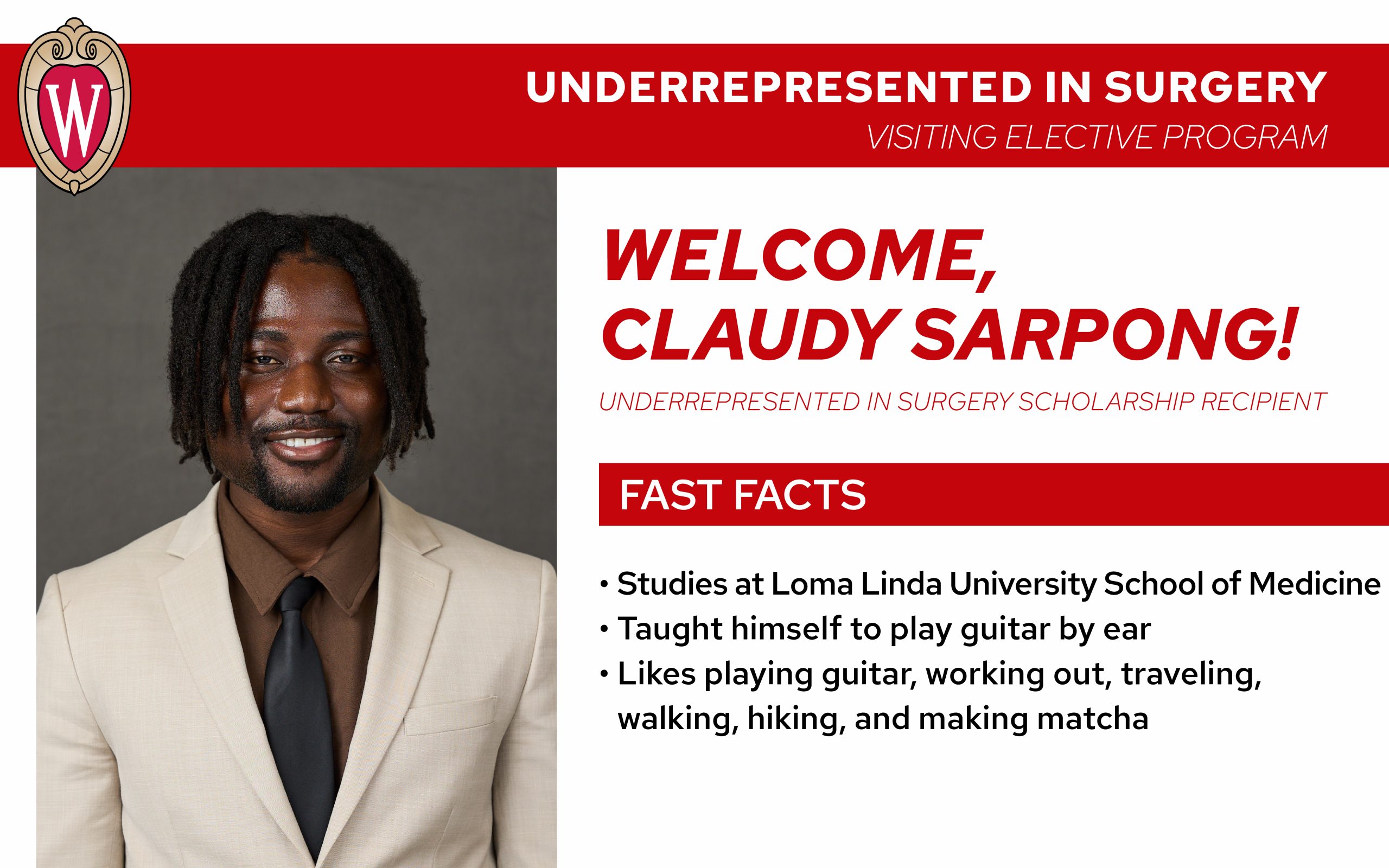
The Underrepresented in Medicine (URiM) Visiting Student Scholarship Program, sponsored by the Department of Surgery, supports qualified 4th year medical students from underrepresented backgrounds in medicine in developing their clinical skills, abilities, and potential through a visiting rotation, mentorship, and networking opportunities.
Claudy Sarpong, a medical student at Loma Linda University School of Medicine, grew up in a small village in Ghana, where access to healthcare in general was limited and specialized surgical care was almost nonexistent.
“My interest in plastic surgery really took shape after seeing the impact of reconstructive surgery through mission work—helping people regain function, feel like themselves again and have hope for what comes next,” Sarpong said. “I wanted to pursue a field where I could eventually bring that same kind of care and hope back to communities like the one I grew up in, and to others with limited access to reconstructive surgery.”
Coming from Ghana to the U.S., one of the experiences that has shaped Sarpong most during medical school has been caring for people with many different backgrounds.
“I’ve learned a lot from my patients and from understanding experiences that are different from my own,” Sarpong said. “It has taught me that building trust starts with listening, meeting people where they are and making sure they feel heard and respected. That has really shaped how I want to serve people as a physician.”
Sarpong was drawn to the UW–Madison Department of Surgery for many reasons, but he was especially interested in the department’s approach to global surgery. He valued the department’s emphasis on long-term partnerships, educational exchange and building local capacity. In addition, he appreciated that residents have the opportunity to participate in global health rotations as a part of their training.
“[This] really stood out to me because it reflects the kind of work I hope to be involved in the long term, building lasting partnerships and helping expand access to reconstructive care in underserved communities,” Sarpong said.
During this rotation, Sarpong is looking forward to getting to know the residents and faculty, learning how the team works and seeing what it’s like to train at UW–Madison. He is also excited to be in the operating room and learn from the breadth of cases.
“More than anything, I want to contribute to the team, grow during the month and get a real sense of the culture of the program,” Sarpong said.
In the future, Sarpong’s goal is to become a well-rounded plastic and reconstructive surgeon, and eventually help build lasting partnerships between academic programs and hospitals in underserved communities.
“I hope to create opportunities for residents to rotate abroad while local surgeons receive longitudinal training and mentorship, with the goal of strengthening reconstructive care within their own communities,” Sarpong said. “I also hope to continue working on remote surgical technology as another way to expand access to expertise where it is limited.”