May 27, 2026
Kelly Meyerhofer (photos: Hannah Schroeder)
Milwaukee Journal Sentinel
MADISON – Maks Makarenkov couldn’t help but smile on car rides through the capital city. He saw homes with blue and yellow flags pinned in their windows or dangling from flagpoles.
“Seeing the Ukrainian flags here, it touches my heart,” Makarenkov said. “In this war, we feel the American support.”
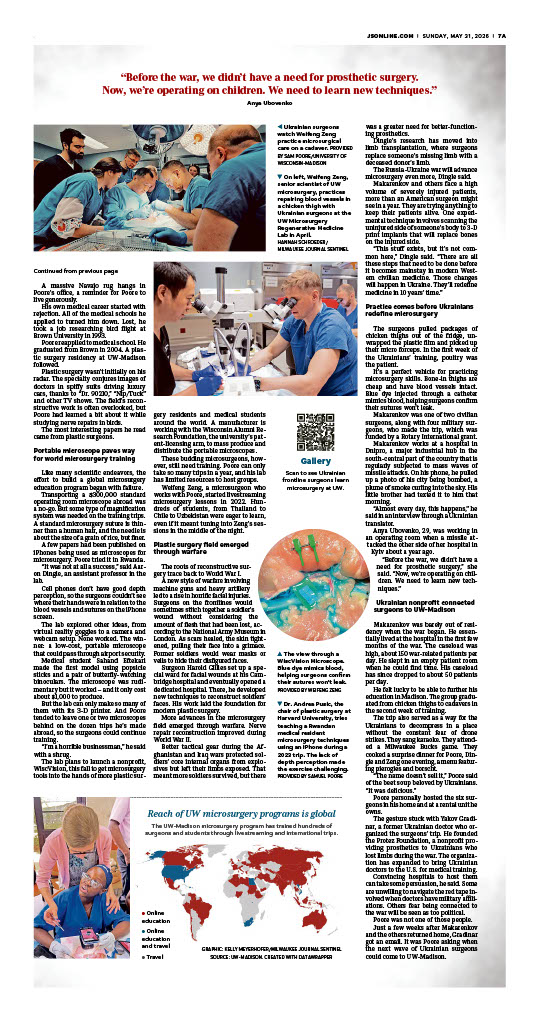
It was Makarenkov’s first time in the U.S. but he wasn’t there to sightsee. He and five other Ukrainian surgeons were learning the nitty-gritty of microsurgery during a two-week intensive training at the University of Wisconsin-Madison medical school.
Makarenkov, 29, has brown hair and a boyish face that hides the horrors Ukrainian surgeons have seen over the last
four years: 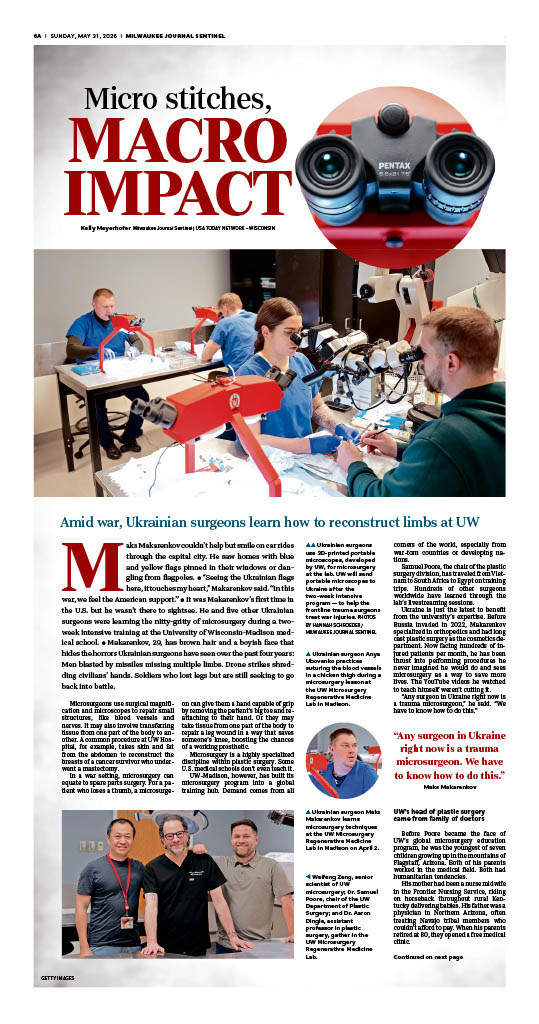 Men blasted by missiles missing multiple limbs. Drone strikes shredding civilians’ hands. Soldiers who lost legs but are still seeking to go back into battle.
Microsurgeons use surgical magnification and microscopes to repair small structures, like blood vessels and nerves. It may also involve transferring tissue from one part of the body to another. A common procedure at UW Hospital, for example, takes skin and fat from the abdomen to reconstruct the breasts of a cancer survivor who underwent a mastectomy.
In a war setting, microsurgery can equate to spare parts surgery. For a patient who loses a thumb, a microsurgeon can give them a hand capable of grip by removing the patient’s big toe and reattaching to their hand. Or they may take tissue from one part of the body to repair a leg wound in a way that saves someone’s knee, boosting the
chances of a working prosthetic.
Microsurgery is a highly specialized discipline within plastic surgery. Some U.S. medical schools don’t even teach it.
UW-Madison, however, has built its microsurgery program into a global training hub. Demand comes from all corners of the world, especially from war-torn countries or developing nations.
Samuel Poore, the chair of the plastic surgery division, has traveled from Vietnam to South Africa to Egypt on training trips. Hundreds of other surgeons worldwide have learned through the lab’s livestreaming sessions.