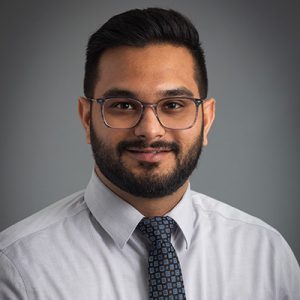
General surgery resident Kaleem Ahmed, MBBS, MSAI has a passion for global surgery and global oncology. Having grown up in Pakistan, he witnessed and experienced the challenges that healthcare systems in under-resourced countries face as a result of financial constraints, geopolitical instability, insufficient healthcare infrastructure, and a limited trained workforce. The recipient of the 2026 H.O.P.E. Hawassa Resident Research Scholarship from the American College of Surgeons, Ahmed will now have the first opportunity of his early professional career to impact cancer care capacity-building in sub-Saharan Africa. The scholarship provides funding to support a research project between a U.S.-based surgery resident and collaborators in Hawassa, Ethiopia.
Ahmed is presently pursuing a Clinical Informatics fellowship during his two years of academic development time and is concurrently engaged in global surgery and surgical outcomes research under the mentorship of Division of Surgical Oncology Assistant Professor Dr. Nabeel Zafar. For his research, he will be working with local mentors and colleagues at the Hawassa University Comprehensive Specialized Hospital (HUCSH) to conduct a gap analysis and needs assessment of the hospital’s oncology care delivery systems.
“Cancer incidence is increasing rapidly across Ethiopia, and HUCSH serves as a major referral center for oncology care in southern Ethiopia,” explained Ahmed. “However, there is limited data on the current status of their oncology capacity in terms of infrastructure readiness, staffing, diagnostic capacity, referral systems, tumor board processes, cancer registry operations, and care coordination, as well as their readiness for artificial intelligence and digital health-based solutions.”
Ahmed’s structured analysis will include characterizing HUCSH’s strengths and operational gaps in cancer care delivery when compared against international oncology care standards. Because these standards were largely developed in high-income countries and may not fully reflect the realities of low-resource health systems, he will partner with local mentors and collaborators to also conduct interviews with HUCSH leadership and staff to gain their perspectives on which gaps are most important, feasible, and actionable within the Ethiopian context. From this assessment, he will then work with his colleagues at HUCSH to establish short- and long-term priorities for local cancer care improvement efforts. Finally, Ahmed will work with HUCSH and the Cancer Diseases Hospital in Lusaka, Zambia, an established comprehensive cancer care center affiliated with the University of Zambia Teaching Hospitals, to facilitate shared bidirectional learning, mentorship, and dissemination of best practices that can be adapted to and are relevant for the Ethiopian oncology context.
“I’m incredibly proud of Kaleem for securing this award,” said Zafar. “His research will be incredibly helpful as HUCSH continues to expand their oncology services. It will also inform future development of a locally adapted framework for cancer center standards that can be used not only in Ethiopia but in other low-resource settings.”