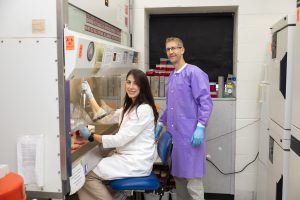
 When talking about cancer research, much of the conversation centers around breast, prostate, lung and colorectal cancer – and rightly so as those cancers account for nearly 50% of all new cancer diagnosis in the U.S. However, there are a group of cancers labeled “ultra-rare,” those affecting fewer than 15 per 100,000 people annually, in which important and potentially life-saving research is being conducted.
One of those “ultra-rare” cancers is fibrolamellar carcinoma (FLC), a form of liver cancer that primarily occurs in adolescents and young adults who have no history of liver disease. FLC is thought to make up 1-5% percent of all liver cancers, affecting both men and women, but it is so rare that there is little data on how many people actually have FLC.
“The average survival is roughly 30-40% at five years. So when you combine that with an average age of diagnosis of 22, it’s pretty devastating.”
— Dr. Sean Ronnekleiv-Kelly, associate professor, Division of Surgical Oncology
“It’s estimated there are probably about 200-300 patients diagnosed per year,” says Sean Ronnekleiv-Kelly, MD, associate professor in the Division of Surgical Oncology. “The average survival is roughly 30-40% at five years. So when you combine that with an average age of diagnosis of 22, it’s pretty devastating.”
Dr. Ronnekleiv-Kelly has devoted much of his scientific career to the study of FLC. His research is focused on improving detection methods and treatment options.
“They go hand in hand,” he said. “If we can understand the origins and development of FLC from an early transformed cancer cell to a pre-cancerous tumor and an invasive carcinoma, we can get a gauge on how these tumors develop, which should help in terms of identifying ways to detect them earlier. That should also help us to better understand ways to target this tumor with therapeutics.”
As is often the case in an academic surgery environment linked with a health system as robust as UW Health, the clinical realities helped influence Dr. Ronnekleiv-Kelly’s research goals.
“We had seen a couple of individuals here at UW-Madison with this type of cancer,” Dr. Ronnekleiv-Kelly said. “It was extraordinary to me that we didn’t have great options for these folks. Outside of surgery, there are no proven therapies. The other part that’s really devastating is that it afflicts young individuals. The compilation of those factors really motivated me to pursue this line of research.”
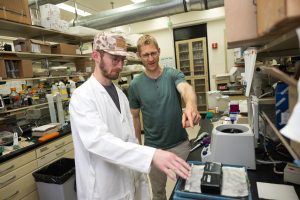
For the last few years, the Ronnekleiv-Kelly lab has been studying FLC in animal models and in human tissue. This led to the discovery of a protein that wasn’t functioning properly in patients with FLC.
“We found that this protein, CDK7, is abnormally activated in FLC cancer cells, and that its presence alters gene expression in a way that can cause the cancer cells to multiply more quickly,” explained Dr. Ronnekleiv-Kelly. “We also found that inhibiting CDK7 function can actually cause FLC cancer cells to die. This tells us that CDK7 inhibition could potentially be a good target for drug development.”
With a grant from the Fibrolamellar Cancer Foundation, Dr. Ronnekleiv-Kelly has been testing this theory by transplanting human FLC tumor tissue into mice, which is the next step to help the researchers determine if targeting CDK7 could be a way to treat FLC. This will allow them to look more closely at how CDK7 inhibition works and whether it has any side effects. They will also be able to combine it with other promising drugs to see if the combination of drugs is more powerful than one drug alone in killing FLC cancer cells.
“We have people all over campus in different departments that are really leaders in their respective fields. It’s amazing how many talented individuals there are here.”
— Dr. Sean Ronnekleiv-Kelly, associate professor, Division of Surgical Oncology
Researchers also recently discovered that a gene mutation caused by two specific genes fusing together may be a driver of not only FLC but also equally rare and lethal cancers of the pancreas and bile duct. Armed with this knowledge, Dr. Ronnekleiv-Kelly saw an opportunity to scientifically attack three cancers with one proverbial stone.
“The gene that has been linked to all three cancers is the DNAJB1-PRKACA fusion,” said Ronnekleiv-Kelly. “It’s a gene fusion that my lab has been studying for the last six years, and it’s one for which we developed a mouse model that allows us to introduce the DNA alteration into specific cells of mouse organ systems, including the liver, pancreas, and bile ducts, so we can monitor these mutant cells to see how they change over time.”
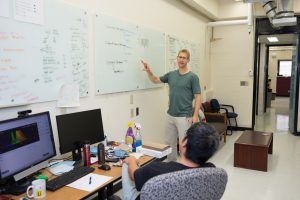
Working with a pathologist at the Mayo Clinic in Rochester, Ronnekleiv-Kelly is using this mouse model and tapping into the resources of the cutting-edge UW Biotechnology Center to confirm the biological overlap of DNAJB1-PRKACA as a cause for all three forms of cancer. The research team will also examine another gene, SLC16A14, the over-expression of which was discovered by researchers at Cornell University and has been strongly linked to FLC. If SLC16A14 is similarly over-expressed in other biliary and pancreatic cancers, it could present a potential target for the development of new therapies.
“Dr. Ronnekleiv-Kelly’s unwavering dedication to decoding ultra-rare malignancies, such as fibrolamellar carcinoma, is nothing short of transformative,” said Sharon Weber, MD, professor and Chair of the Division of Surgical Oncology. “By isolating critical mechanisms like CDK7 activation and the DNAJB1-PRKACA mutation, he is not merely conducting research; he is architecting a beacon of hope for patients facing the most challenging diagnoses.”
As evidenced by the ongoing research, collaboration is often the key to any breakthrough. And Dr. Ronnekleiv-Kelly believes that UW-Madison, with all of its resources and its strong commitment to research, is the optimal place for his lab.
“We have people all over campus in different departments that are really leaders in their respective fields,” Dr. Ronnekleiv-Kelly said. “It’s amazing how many talented individuals there are here. When you can have joint lab meetings in person, it’s incredibly beneficial and really helps to streamline progress.
“In trying to identify therapies or early detection, it’s impossible to do everything on your own,” he continued. “You really need those collaborations. Otherwise, you’re going to struggle to make advancements. So, it’s been fantastic being here at UW-Madison.”
“One of the things unique about UW is the philanthropic support. That has also been a critical mainstay for my lab, the generous and kind gifts from donors. It allows you to essentially pivot with the science.”
— Dr. Sean Ronnekleiv-Kelly, associate professor, Division of Surgical Oncology
Another challenge that Dr. Ronnekleiv-Kelly has had to face is not an uncommon one in the research world: funding. While his lab’s work has been recognized with multiple grants from the Fibrolamellar Cancer Foundation, money for studies on “ultra-rare” cancers can be hard to come by.
“If you have one or two patient-derived models in comparison to other cancers where you could get 25, 30, it may seem that what you’re attempting to investigate is fairly limited in nature,” Dr. Ronnekleiv-Kelly said. “So I think it can be a challenge to overcome that with some of the standard funding paradigms.”
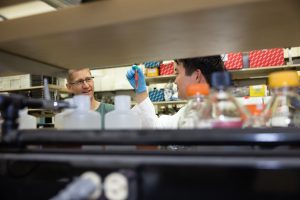
In addition to the Fibrolamellar Cancer Foundation, Dr. Ronnekleiv-Kelly points out the Department of Defense has specific rare cancer research paradigms. He also praised the resources available on campus.
“One thing that’s been great at UW-Madison is that there are so many pilot awards available to help push things forward,” Dr. Ronnekleiv-Kelly said. “It could be anything from the Carbone Cancer Center pilot awards to a pilot award utilizing a specific technology. If that’s the case, a $20,000 experiment, for example, is taken care of and you can make advancements. That’s one of the things that has been fantastic here at UW is that there are avenues to push things forward, even if standard funding isn’t available.”
Dr. Ronnekleiv-Kelly is also quick to acknowledge the significant role private donations make in his work, and others across campus.
“One of the things unique about UW is the philanthropic support,” Dr. Ronnekleiv-Kelly said. “That has also been a critical mainstay for my lab, the generous and kind gifts from donors. It allows you to essentially pivot with the science. You can analyze the data in real time, determine what the next best steps are going to be, and go in that direction without having to take a step back and pause for 6 to 12 months while you’re waiting for additional grant funding to come in. It’s one of the things that’s been unique about UW in comparison to some of my peers and colleagues around the country.”
“Working with Dr. Ronnekleiv-Kelly has been one of the most impactful experiences in my training.”
— Dr. Patrick Carney, resident, General Surgery Residency Program
Himself a product of the general surgery residency at the UW–Madison School of Medicine and Public health, Dr. Ronnekleiv-Kelly embraces his role as an educator, training and inspiring the next generation of surgeon-scientists.
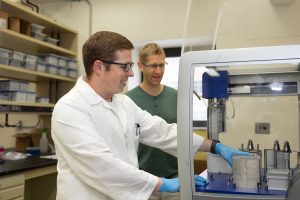
“Working with Dr. Ronnekleiv-Kelly has been one of the most impactful experiences in my training,” said Patrick Carney, MD, PhD, a current general surgery resident in his second year in the Ronnekeliv-Kelly lab. “He models the surgeon-scientist pathway, balancing excellence in patient care and research. He encourages us to do experiments that will help patients first and foremost. His passion for the work is infectious and his commitment to mentoring and promoting myself and others in the lab has had a tremendous positive impact on my career trajectory.”
“Dr. Ronnekleiv-Kelly has been the single-most influential mentor in my training as a surgeon-scientist,” said Patrick Schwartz, MD, PhD, a former resident in the UW Department of Surgery who is now a Complex General Surgical Oncology fellow at Memorial Sloan Kettering. “Despite the pressures of being a tenure-track surgeon scientist, he makes you feel like he is putting all of his effort into making you a better writer, benchtop scientist, and thinker. I hope to one day emulate his style and teachings.”
With the level of campus and philanthropic support he has encountered and the momentum that has been achieved, Dr. Ronnekleiv-Kelly is optimistic about what the future can bring in the detection and treatment of FLC and other highly rare but potentially deadly diseases.
“I think that we have started to accumulate a number of advances in this spectrum of cancers,” he said. “We have really dialed in on a couple of exciting therapeutic targets and the data is extraordinarily promising. The next step is translating a lot of the work that we’ve done towards potential patient therapies. It’s a long road and there’s a lot that has to be done, but that’s why it’s so exciting. And I do think that within 10 years, we’re going to have a much stronger repertoire of therapy for these patients.”
“As a preeminent surgeon-scientist, Dr. Ronnekleiv-Kelly seamlessly bridges the gap between the operating room and the laboratory, demonstrating a level of focus that is redefining the landscape of cancer biology,” Dr. Weber said. “His pioneering work in identifying novel therapeutic targets and advancing early detection ensures that his legacy will be measured in the lives of generations of patients who will benefit from significantly improved clinical outcomes.”
If you would like to support the ground-breaking research happening in the Ronnekleiv-Kelly lab or throughout the Department of Surgery, please visit our “Give” page or contact Lindsay Kindschy, Director of Development.
By Brian Lucas, Director of Marketing and Communications